One date in. A daily system out.
PeriFlow turns your cycle data into phase-matched guidance for eating, fasting, and moving — and keeps working when your cycles don't behave. Here's the whole loop, start to finish.
Start with one date
Tell PeriFlow when your last period started. Not sure? Skip it — you can adjust any time, and the app settles on the right rhythm as you log. Then pick your diet style (Mediterranean, omnivore, vegetarian, vegan, paleo, keto, or custom) and rate a quick baseline of your main symptoms, so PeriFlow knows what "your normal" looks like.
At the end of setup you're asked about reminders. Say yes and PeriFlow turns on a single daily check-in at 8:00am — one nudge, nothing else. Change the time or switch it off entirely in Settings, any time.
If you're on HRT, you say so here — it changes how everything downstream behaves.
PeriFlow finds your phase
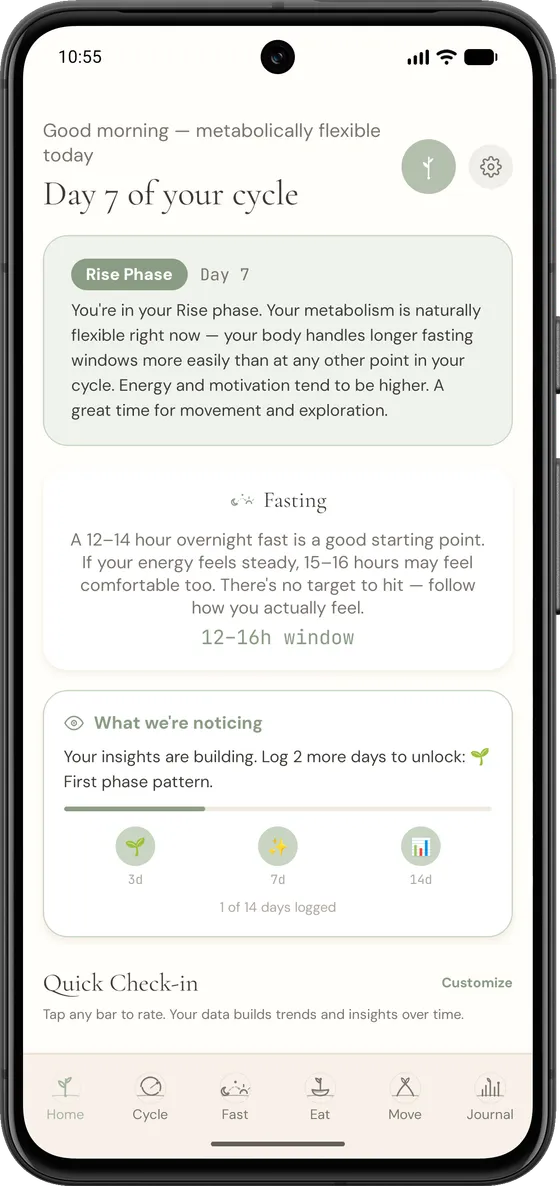
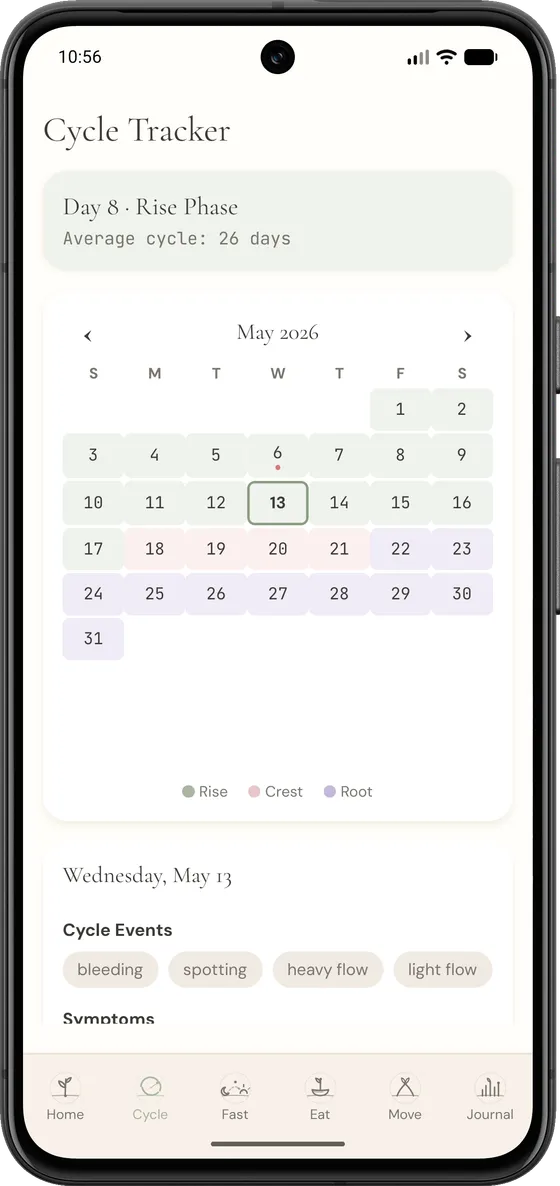
Every morning the phase engine answers one question: where is your body today? Rise (early cycle — resilient, metabolically flexible), Crest (the brief ovulatory peak), or Root (the progesterone half, where most symptoms live). In perimenopause cycles stretch, shorten, and skip — so PeriFlow works from your actual range, handles spotting and 60-day gaps, and never forces your data into a textbook 28-day template.
Your day adapts
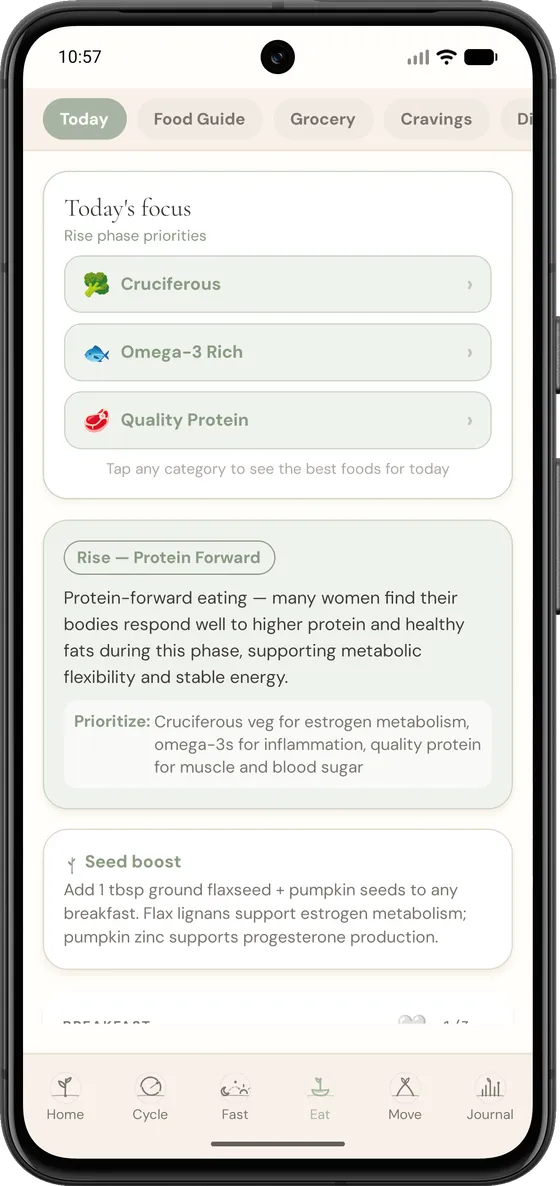
Eat: meal suggestions matched to your phase and diet style — with a "why this meal?" explanation connecting the ingredients to your hormones today, and swaps when something doesn't appeal.
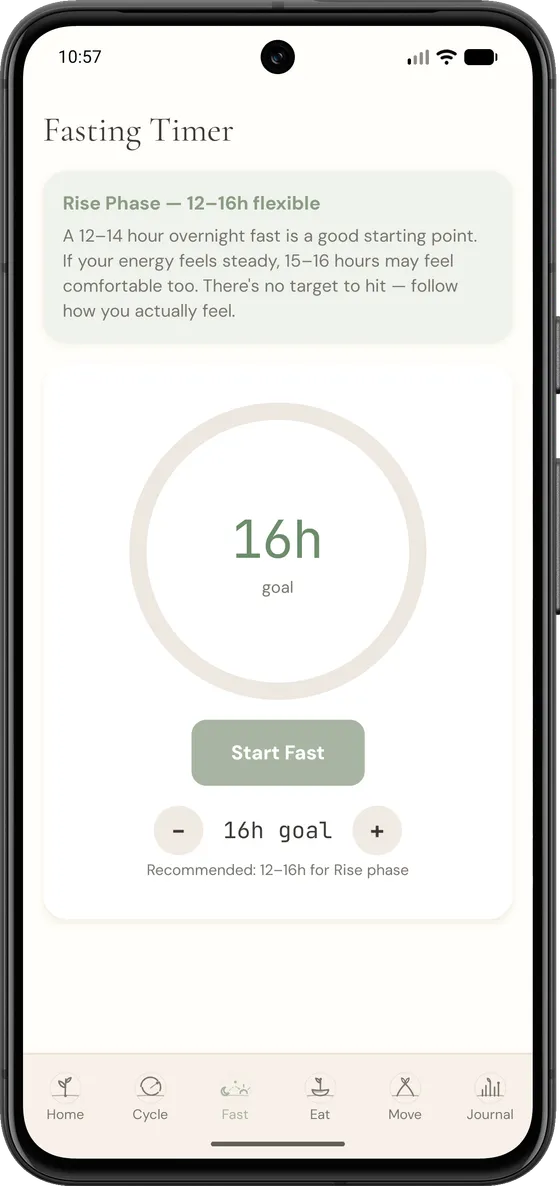
Fast: your fasting window follows your cycle — flexible 12–16 hours in Rise, moderate in Crest, and no fasting in Root, when progesterone needs glucose. The app doesn't just suggest this; it protects it.
Move: phase-appropriate movement — strength and intensity when your hormones support it, gentler work when they don't.
Log what you feel — in under a minute
If you turned reminders on, this is the part that comes to you: one check-in a day, at a time you choose. You don't have to remember to open the app.
The check-in rates your key symptoms on a simple 1–5 scale — energy, sleep, hot flashes, mood, brain fog, and up to 23 in all. Flow tags keep your cycle record accurate. The journal is there for anything the numbers can't hold, and it pre-fills from your check-in so you're never starting from a blank page.
Your plan adjusts to what you logged
Everything so far adapts your day to your phase. This is where it starts adapting to you.
After about three days of logging, PeriFlow works from your recent averages rather than any single bad day. If something's running high — hot flashes, anxiety, joint pain — or running low, like energy, sleep, or mood, the rest of the app shifts around it:
Your meals reorder. The foods and recipes associated with what you're experiencing move to the top of the list, each marked so you can see why it's there.
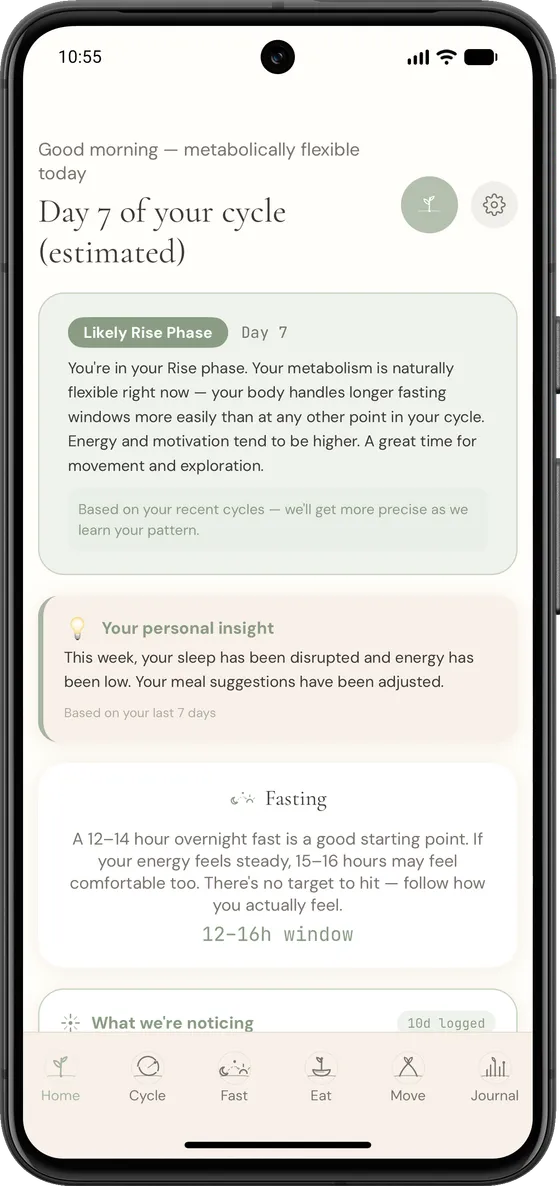
Your fasting window shortens. Disrupted sleep or elevated hot flashes bring it down to a gentler window. It only ever shortens — PeriFlow will never push you to fast longer on a week you're struggling.
Your movement softens. Lower-impact options come first and the day's intensity eases back, with a line explaining what prompted it.
And once you've logged about a week, it says so out loud. A card on your dashboard tells you in plain language what it picked up — "this week, your sleep has been disrupted and energy has been low" — so the change is never something that happens behind your back.
The wait is deliberate. One rough Tuesday isn't a pattern, and an app that reacts to it isn't personalising — it's guessing. PeriFlow stays quiet until it has enough to be reasonably sure.
Patterns become visible
This is where daily logging pays off. PeriFlow correlates what you ate, when you fasted, and how you felt — and surfaces the connections as plain-language insights: which foods track with your better days, how your sleep moves across phases, how this cycle compares to your baseline. The "sometimes it works, sometimes it doesn't" mystery usually turns out to have a phase-shaped explanation.
Walk into your GP appointment with data
"I'm fine in week one and a mess in week three" is a hard thing to convey in a ten-minute appointment — and it's exactly the kind of pattern that gets dismissed as stress. PeriFlow generates a clinical-ready export: a formatted report of your symptom trends, cycle history, and logs, with a notes section for the questions you want to ask. Your experience, as evidence.
Many women find this changes the conversation — whether that conversation is about HRT, sleep, or simply being taken seriously.
Common questions
Do I need regular cycles for PeriFlow to work?
No — PeriFlow was built for irregular cycles. It handles cycles that stretch, shorten, and skip, including gaps of 60+ days, without defaulting to a textbook 28-day model. Predictions are based on your range, not a single date.
Does PeriFlow work if I'm on HRT?
Yes. Continuous HRT smooths the hormonal cycle, so PeriFlow switches to steady, symptom-driven guidance. Cyclical HRT keeps a rhythm, so guidance stays phase-aware. PeriFlow works alongside your treatment, never instead of it. More detail in our HRT guide.
Does PeriFlow tell me what to do about my symptoms?
It adapts rather than prescribes. When you log a symptom consistently, PeriFlow reorders your meal and movement suggestions toward what's associated with it, shortens your fasting window, and tells you plainly what it noticed. What it won't do is diagnose you, name a cause, or tell you to take anything — it shows you your own patterns and leaves the decision with you. For anything clinical, the export in step 7 is built to take to your GP.
Is my health data private?
Yes. Encrypted in transit and at rest, stored in the EU (Ireland), never sold or shared with advertisers — and you can delete your account and every trace of your data from inside the app. Full detail in the Privacy Policy.
What's free and what's premium?
Phase tracking, the cycle calendar, and the symptom journal are always free. The full experience — phase-matched meals across seven diet styles, cycle-aware fasting, and correlation insights — comes with a 7-day free trial, then a monthly or annual subscription.